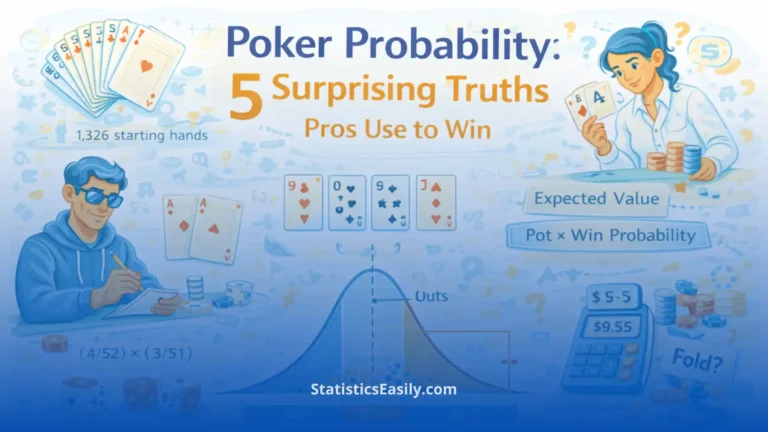


Poker Probability for Beginners: A Complete Guide
If you can count, you can learn to think like a poker player. Poker looks like luck in the short run, but underneath every decision there is combinatorics, probability, and expected value (EV). In this guide you’ll learn the building blocks: how to compute the odds of each 5-card hand, how conditional information changes probabilities in Texas Hold’em, and how to simulate scenarios with Python to validate your intuition. The goal is not to promise winnings—it’s to help you make informed decisions, understand variance, and appreciate the beauty of statistical reasoning at the table.
Educational note: This content is for learning statistics and decision-making. It does not guarantee profits or encourage gambling.
What You’ll Learn (Summary)
- How a standard 52-card deck translates into combinatorial counts.
- Exact probabilities of classic 5-card hands.
- How conditional probability and new cards (flop/turn/river) update your chances.
- The meaning of pot odds, implied odds, and EV.
- How to run Monte Carlo simulations in Python to estimate win rates.
1) The Deck, Combinations, and the Language of Probability
A standard deck has 52 cards: 13 ranks (A,2,…,K) × 4 suits (♠♥♦♣). In 5-card poker, every distinct hand is a 5-card combination without order:
\text{Total 5-card hands}=\binom{52}{5}=\dfrac{52!}{5!,47!}=2{,}598{,}960This number is the denominator for all exact 5-card probabilities. For Texas Hold’em, where you receive 2 hole cards and combine them with 5 community cards, we often resort to conditional counting or simulation because sequences of deals and player interactions make the algebra messy.
2) Exact Odds of 5-Card Poker Hands
Below are standard counts and probabilities for 5-card draw hands. You can re-derive each using combinations; I show one derivation, then provide the table.
Example derivation: One Pair
- Choose the rank of the pair: \binom{13}{1}.
- Choose the 2 suits for that rank: \binom{4}{2}.
- Choose 3 distinct ranks (not the pair’s rank) from the remaining 12: \binom{12}{3}.
- For each of those 3 ranks, choose 1 suit from 4: 4^{3}.
Standard 5-Card Hand Probabilities
| Hand Type | Combinational Count | Probability |
|---|---|---|
| Royal Flush | 4 | 0.000154% |
| Straight Flush (ex-Royal) | 36 | 0.001385% |
| Four of a Kind | 624 | 0.0240% |
| Full House | 3,744 | 0.1441% |
| Flush (ex-straight flush) | 5,108 | 0.1965% |
| Straight (ex-straight flush) | 10,200 | 0.3925% |
| Three of a Kind | 54,912 | 2.1128% |
| Two Pair | 123,552 | 4.7539% |
| One Pair | 1,098,240 | 42.2569% |
| High Card (no pair, no straight/flush) | 1,302,540 | 50.1177% |
3) From Counting to Decision-Making: Pot Odds and EV
Counting is the foundation; decisions hinge on expected value (EV). If an action yields outcomes x_i with probabilities p_i, then:
\mathrm{EV}=\sum_{i} p_i,x_iIn poker, x_i is monetary: the chips you win (+) or lose (−). A call is profitable if \mathrm{EV} > 0. With a drawing hand, we often compare pot odds to drawing odds.
- Pot odds (as a ratio) = \dfrac{\text{amount to call}}{\text{pot after calling}}.
- Break-even probability p^{\ast} needed to call:
Example: Pot is $90, opponent bets $10, you must call $10 to see the next card. Pot after calling becomes $110.
Break-even p^{\ast} = \dfrac{10}{110} \approx 9.09%.
If your chance to improve (and win) exceeds 9.09%, the call has positive chip EV—ignoring future betting (that’s implied odds).
4) Outs and Approximation Rules at the Table
An out is an unseen card that improves your hand to likely best. With one card to come (river), probability of hitting at least one of your k outs from the remaining unseen cards is approximated by:
P(\text{hit on river})\approx \dfrac{k}{46}With two cards to come (turn and river), a handy approximation is the Rule of 4 and 2:
- After the flop (two cards to come), estimated chance \approx 4k%.
- After the turn (one card to come), estimated chance \approx 2k%.
Common outs
- Open-ended straight draw: k=8 → ~32% by river (Rule of 4).
- Flush draw (after flop): k=9 → ~36% by river.
- Overcard pair (two overcards): roughly k=6 → ~24% by river.
5) Conditional Probability in Texas Hold’em
Information arrives in stages (pre-flop → flop → turn → river). Each reveal conditions the probability space. If A is the event “I make a flush by river” and B is the event “flop shows two of my suit,” then:
P(A\mid B)=\dfrac{P(A\cap B)}{P(B)}Rather than work through complex enumerations every time, players use outs and approximations—or they simulate.
Example: Flush by river given a 4-flush after the flop
You hold two hearts; the flop shows two hearts, giving you 4 hearts combined and 9 outs (13 hearts − 4 seen). Exact complementary calculation for “miss both turn and river”:
So,
P(\text{make flush by river})\approx 1-0.676=0.324which matches the Rule of 4 intuition for k=9 after the flop.
6) Python: Counting, Odds Tables, and a Tiny Simulator
You don’t need a solver to learn. Start with three useful scripts.
6.1 Count 5-Card Hand Probabilities Exactly
import math

def nCk(n, k):
    return math.comb(n, k)

total = nCk(52, 5)

counts = {
    "royal_flush": 4,
    "straight_flush_ex_royal": 36,
    "four_of_a_kind": 624,
    "full_house": 3744,
    "flush_ex_straight_flush": 5108,
    "straight_ex_straight_flush": 10200,
    "three_of_a_kind": 54912,
    "two_pair": 123552,
    "one_pair": 1098240,
    "high_card": 1302540
}

for hand, c in counts.items():
    p = c / total
    print(hand, c, f"{100*p:.6f}%")
6.2 Outs, Pot Odds, and EV Helper
def break_even_prob_to_call(amount_to_call, pot_before_call):
    pot_after_call = pot_before_call + amount_to_call
    return amount_to_call / pot_after_call

def approx_hit_prob(outs, cards_to_come=1):
    # Rule of 2 and 4
    if cards_to_come == 1:
        return min(1.0, outs * 2 / 100)
    elif cards_to_come == 2:
        return min(1.0, outs * 4 / 100)
    else:
        raise ValueError("cards_to_come must be 1 or 2")

def call_chip_ev(amount_to_call, pot_before_call, win_prob):
    pot_after_call = pot_before_call + amount_to_call
    # EV = win_prob * pot_after_call - (1 - win_prob) * amount_to_call
    return win_prob * pot_after_call - (1 - win_prob) * amount_to_call

# Example:
to_call = 10
pot = 90
p_be = break_even_prob_to_call(to_call, pot)
p_approx = approx_hit_prob(outs=9, cards_to_come=2)  # flush draw after flop
ev = call_chip_ev(to_call, pot, p_approx)
print("Break-even prob:", round(p_be, 4))
print("Approx win prob:", round(p_approx, 4))
print("Chip EV of call:", round(ev, 2))
6.3 Mini Monte Carlo for Heads-Up Hold’em (very simplified)
import random
from collections import Counter
from itertools import combinations

ranks = "23456789TJQKA"
suits = "CDHS"
deck = [r+s for r in ranks for s in suits]

def hand_rank_5(cards5):
    rs = sorted([c[0] for c in cards5], key=ranks.index)
    ss = [c[1] for c in cards5]
    is_flush = len(set(ss)) == 1
    vals = sorted([ranks.index(r) for r in rs])
    is_straight = all(vals[i]+1 == vals[i+1] for i in range(4)) or vals == [0,1,2,3,12]
    cnt = Counter(rs).most_common()
    counts = sorted([c for _, c in cnt], reverse=True)
    if is_straight and is_flush: cat = 8
    elif counts == [4,1]:        cat = 7
    elif counts == [3,2]:        cat = 6
    elif is_flush:               cat = 5
    elif is_straight:            cat = 4
    elif counts == [3,1,1]:      cat = 3
    elif counts == [2,2,1]:      cat = 2
    elif counts == [2,1,1,1]:    cat = 1
    else:                        cat = 0
    order = []
    for r,c in sorted(cnt, key=lambda x:(x[1], ranks.index(x[0])), reverse=True):
        order += [r]*c
    key = tuple(sorted([ranks.index(r) for r in order], reverse=True))
    return (cat, key)

def best_5_from_7(cards7):
    best = None
    for comb in combinations(cards7, 5):
        rank = hand_rank_5(comb)
        if best is None or rank > best:
            best = rank
    return best

def simulate_heads_up(hole_hero, iters=20000):
    wins = ties = 0
    for _ in range(iters):
        d = deck.copy()
        for c in hole_hero:
            d.remove(c)
        random.shuffle(d)
        villain = d[:2]
        board = d[2:7]
        hero_best = best_5_from_7(hole_hero + board)
        vill_best = best_5_from_7(villain + board)
        if hero_best > vill_best: wins += 1
        elif hero_best == vill_best: ties += 1
    return (wins + 0.5*ties) / iters

# Example: simulate A♠K♠
hero = ["AS", "KS"]
wr = simulate_heads_up(hero, iters=5000)
print("Estimated win rate for AK suited (heads-up):", round(100*wr, 2), "%")
7) Bayes’ Theorem: Updating Beliefs from Opponent Actions
Poker is not just cards; it’s inference about ranges. Bayes’ theorem formalizes how new evidence (an opponent’s bet, check, or raise) updates your belief about their hand.
P(H\mid E)=\dfrac{P(E\mid H),P(H)}{P(E)}- H: hypothesis (opponent holds a strong hand).
- E: evidence (opponent 3-bets pre-flop).
- P(H): prior—how often this player is strong before seeing the action.
- P(E\mid H): likelihood—how likely a strong hand would 3-bet here.
- P(H\mid E): posterior—updated probability after observing the 3-bet.
In practice, we approximate priors from population tendencies (e.g., a tight player 3-bets ~3–5% of hands), then refine with our sample of hands seen.
8) Variance vs. Skill: Why Math Wins in the Long Run
Short-term results are noisy. Even with a positive-EV strategy, you will endure losing streaks. Over many hands, the Law of Large Numbers tells us that sample averages approach true means. If your decisions systematically have \mathrm{EV} > 0, your long-run expected profit is positive, though the variance (swinginess) can be large.
A simple way to visualize this is to simulate a biased coin (EV>0) and look at cumulative profit paths—many paths will be negative in the short run, but the trend is upward as trials grow. The same is true for poker: the truth of EV emerges with volume and discipline.
9) Ethical Play: Bankroll Management and Self-Control
Mathematics helps you avoid self-deception:
- Set bankroll rules (e.g., buy-in ≤ 5% of bankroll for cash games; ≥ 100 buy-ins for tournaments is a conservative rule of thumb).
- Respect stop-loss and stop-win limits to reduce tilt.
- Remember that informed play still carries risk. The goal is better decisions, not certainty.
10) Putting It Together: A Beginner’s Study Plan
- Memorize the 5-card odds table and understand the combinatorics.
- Practice outs and the Rule of 4 and 2 until you can compute them instantly.
- Use the pot-odds and EV helpers to check real hands you’ve played.
- Run Monte Carlo on specific scenarios (your two hole cards vs. a guessed opponent range).
- Add Bayesian thinking: update your model of an opponent based on observed actions.
- Keep a hand journal: decisions, calculations, outcomes. You’ll see patterns and mistakes.
Conclusion
Poker is a rich laboratory for probability, statistics, and rational decision-making. Combinatorics tells you how rare each hand is. Conditional probability and Bayes explain how new information reshapes your beliefs. EV and pot odds turn beliefs into choices. Simulation validates theory and trains intuition. You won’t remove uncertainty—but you will replace guesswork with structure, integrity, and discipline.
Suggested Internal Links
- Expected Value (EV) in Poker: From Pot Odds to Profit
- Monte Carlo Simulation for Poker Hands with Python
- Bayesian Thinking at the Table: Ranges, Likelihoods, and Updates