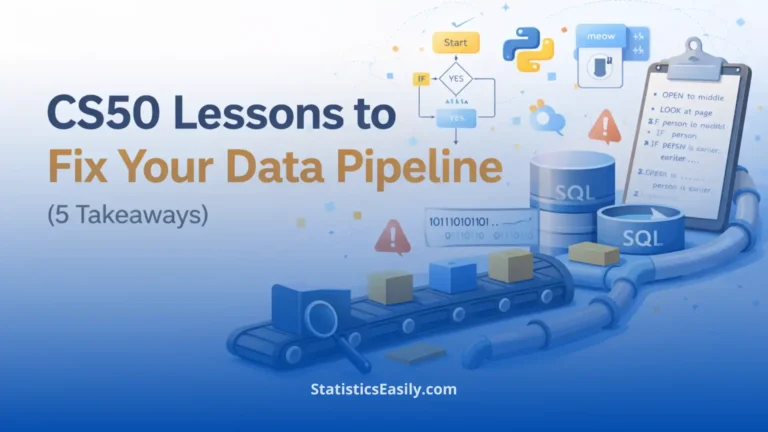


Think Like a Programmer: 4 CS50 Lessons for Your Data Workflow
Data practitioners will learn to apply foundational computational thinking from Harvard’s introductory CS course.
Introduction: The Foundation Before the Code
When debugging a complex SQL query or optimizing a slow Python script, it’s easy to blame the tool’s syntax. But often, the real issue lies deeper—in the computer science fundamentals of logic, efficiency, and structured thinking. These foundational principles are the bedrock upon which robust data solutions are built. Harvard’s acclaimed introductory course, CS50x, provides a masterclass in building this foundation from the ground up, offering powerful lessons for any data practitioner looking to deepen their craft. Este post é uma síntese baseada no CS50x 2025 (Harvard) no YouTube.

1. Start with Logic, Not Syntax
CS50 begins not with lines of code, but with Scratch, a graphical programming language. In Scratch, you build programs by dragging and dropping interlocking puzzle pieces. The key insight is that these pieces “only interlock together if it makes logical sense to do so.” This environment forces the programmer to focus entirely on the logical flow of a program—the sequence of steps, the conditions, and the loops—without the distracting complexities of semicolons, brackets, or correct keyword spelling.
The curriculum separates the act of thinking logically from the act of writing syntactically correct code. By mastering the former in a simplified environment, students are better prepared to handle the latter when they transition to more traditional languages.
Why it matters for data work: Before diving into a complex SQL join or a multi-step data transformation in Python, storyboard it. Sketch out the flow on a whiteboard or write it down in plain-language pseudocode. This simple act of focusing on the logic first can reveal flaws in your reasoning, prevent costly errors, and lead to a far more robust and correct final analysis.
2. Understand the “Why” Behind Your Code
After Scratch, the course transitions to C, a more traditional and lower-level programming language. The stated purpose is to help students learn “how computers work underneath the hood so to speak.” By requiring the programmer to manually manage things like memory and data types—concepts often hidden by modern languages—C forces a direct confrontation with how the machine actually operates.
This isn’t about becoming a C expert. It’s about building a mental model of what the computer is actually doing when you run a script. This foundational knowledge provides the context for understanding why some operations are fast and others are slow, regardless of the language you use for daily work.
Why it matters for data work: This perspective is invaluable for performance tuning. It helps explain why vectorized operations in NumPy or Pandas are orders of magnitude faster than a standard Python for loop—they often leverage compiled C code “underneath the hood.” Being mindful of these underlying processes allows you to write more efficient, scalable Python code for data manipulation.
3. The Deliberate Language Progression
The sequence of languages in CS50—from C to Python to SQL—is not arbitrary. It represents a deliberate educational path that builds from foundational mechanics to high-level application.
Each language serves a distinct purpose in this journey. C is for understanding the fundamentals of computation. Python is introduced as a modern tool to “analyze data, automate processes, [and] build web applications.” Finally, SQL is taught as the language to “read and write lots and lots of data in databases.” This progression teaches not just individual languages, but how different tools solve different problems at different layers of abstraction.
Why it matters for data work: This progression mirrors the mental model of a modern data stack. The journey of data often moves from low-level computation and storage (C’s domain of thinking) to flexible analytical scripting (Python’s role) to structured, large-scale data retrieval (SQL’s purpose). Understanding this separation of concerns helps you choose the right tool for the job and design more effective data pipelines.
4. The Goal Is a Way of Thinking
Ultimately, the course’s primary objective is not to teach a list of languages, but to instill a particular way of solving problems. The goal is to cultivate a mindset that is methodical, precise, and efficient.
“…you’ll learn how to think more methodically, more algorithmically so to speak you’ll learn how to communicate succinctly and precisely and you’ll learn how to solve problems efficiently with code”
— Harvard CS50x 2025 (YouTube) — Lecture: Introduction
This “algorithmic thinking” is the true takeaway. It’s the ability to break a large, ambiguous problem down into a sequence of small, concrete, and logical steps that a computer can execute.
Why it matters for data work: This is the core skill of a data practitioner. It is applied every day when designing a reproducible data cleaning pipeline, constructing a series of business rules in code, defining metrics, or methodically debugging an analysis where the output doesn’t match expectations. The tools may change, but this structured approach to problem-solving remains constant.
O que aplicar hoje
- Before writing a complex function or query, write out the logical steps in plain-language comments first.
- For your next analysis, draw a simple diagram showing how the data will move from its source to the final output.
- When a script is running slowly, pause and ask: “What is the most repetitive operation here, and how could it be done more efficiently?”
- When debugging, state the problem and your expected outcome out loud, as if explaining it to a colleague.
- Read the documentation for one of your favorite library functions (e.g., in Pandas or scikit-learn) to better understand what it’s doing “under the hood.”
Closing: Building Your Foundation
A strong computer science foundation is less about mastering a specific tool and more about adopting a methodical way of thinking. The lessons from CS50 show that focusing on logic before syntax, understanding underlying mechanics, and seeing the bigger picture of how tools fit together are essential for building robust, efficient, and correct data solutions. This perspective is the first and most important step toward moving from simply writing code to architecting sound analytical systems.
Which of these foundational ideas could most improve your current data workflow?
——————————————————————————–
Base: Harvard CS50x 2025 (YouTube).