

From Scripts to Systems: CS Fundamentals for Data
For data professionals and learners, this post distills Harvard’s final CS50 lecture of 2025 into five practical takeaways for more robust work.
Struggling to debug a complex script, optimize a slow SQL query, or ensure an analysis is reproducible? The root of these common data challenges often lies in fundamental computer science principles. As the CS50 lecturer puts it, computer science isn’t about programming per se; “at the end of the day it really is about taking inputs and ideally correctly producing outputs.” This is the very essence of data work. This post extracts key lessons from Harvard’s final CS50 lecture of 2025. Este post é uma síntese baseada no CS50x 2025 (Harvard) no YouTube. Its purpose is to translate these foundational CS concepts into practical, everyday habits that can make your data work more rigorous, reproducible, and impactful.
The Abstraction Gap: Speaking the Machine’s Language
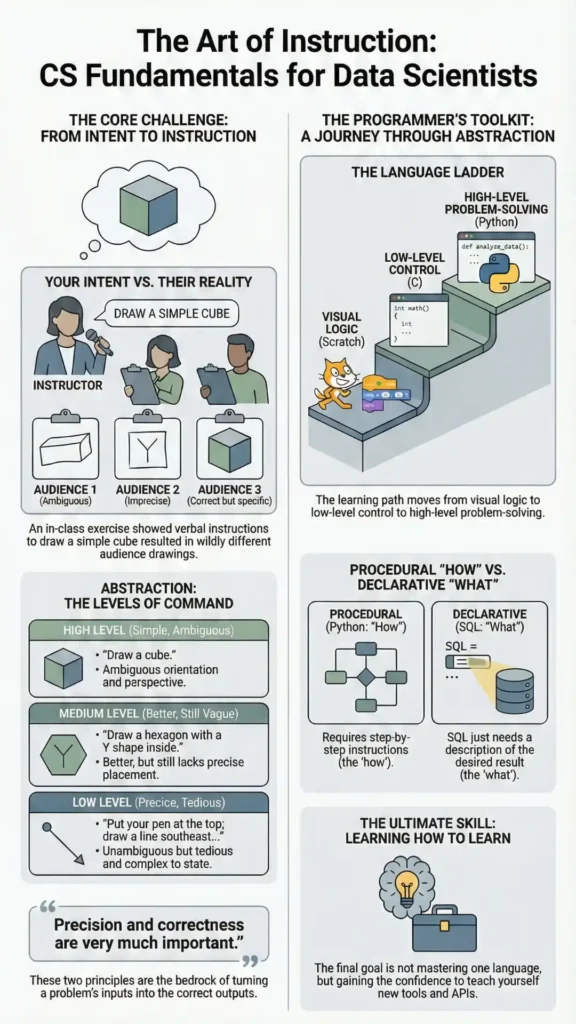
In the lecture, a volunteer (Jordan) was asked to give verbal instructions for an audience to draw a cube. His first, high-level instruction, “visualize a cube,” failed because it was too abstract. Everyone’s mental model was different, leading to inconsistent results. This illustrates a high level of abstraction, where implementation details are hidden.
He then moved to a lower level, telling people to “draw a hexagon with a Y looking shape” inside. This was more concrete but still left room for ambiguity. It wasn’t until the lecturer prompted him for “one more instruction even lower level”—”put your pen at the top of your page… draw a straight line”—that the task became truly unambiguous, much like the block-based commands in a language like Scratch.
Data Science Connection: This “abstraction gap” is critical in data work. A request like “clean the user data” is a high-level abstraction. To make it reproducible, you must translate it into a series of unambiguous, low-level commands: “Cast the signup_date column to a datetime object. Remove all rows where the email field is null. Convert the country column to lowercase.” Precision in your SQL WHERE clauses, Python data transformations, and pipeline documentation is how you close the abstraction gap and ensure your instructions are executed exactly as intended.
The Core Mandate: Precision and Correctness
The lecturer shared a photo of his own notes from his first CS50 class in 1996. The two concepts he had emphasized with exclamation points were that “precision and correctness are very much important.” This isn’t just academic advice; it’s the foundational mandate of programming and the primary tool for closing the abstraction gap.
This principle was demonstrated in a second drawing game where an instruction was given that “the circle is saying High.” While technically followed, the instruction was incomplete. As the lecturer noted, “probably should have specified top left versus some other angle.” The ambiguous specification resulted in the word “Hi” appearing on the wrong side of the figure’s head. A small ambiguity led to an incorrect final result. Once a precise, correct process is defined, however, it can be abstracted away into a reusable tool. As the lecturer concluded, you can “call it a function” and build on top of that reliable solution.
Data Science Connection: In data analysis, correctness is non-negotiable. A small logical error—using < instead of <=, an incorrect join key, or a misplaced parenthesis—can propagate through an entire analysis, leading to faulty business decisions, inaccurate models, and a loss of trust. Demanding precision from yourself and others is the first step toward building correct and reliable data systems.
SQL’s Superpower: Thinking Declaratively
The lecture draws a key distinction between procedural and declarative programming. Most of the course focused on procedural programming, the “step-by-step… instructions for solving problems” that characterize languages like C and Python. In this paradigm, you tell the computer how to do something.
SQL introduces a different way of thinking: declarative programming. This is a powerful form of abstraction where you simply declare what data you want. You specify the tables, conditions, and desired columns, and the database engine’s optimizer is responsible for figuring out the most efficient procedural steps to retrieve that data for you. There are “no more loops and variables and conditionals” for you to manage.
Data Science Connection: Understanding this distinction is a high-leverage concept for anyone who works with data. It helps you write more efficient and readable SQL by focusing on the desired outcome rather than the execution steps. By thinking declaratively, you leverage the database’s power to handle the precise “how,” freeing you to focus on the business logic of your data request.
“SQL though in particular was a different type of language and it let us talk about something what we might now know as declarative programming where doesn’t really matter like how you get the data or how you select it but just that you want to select some data…” — Harvard CS50x 2025 (YouTube) — Lecture: The End
Focus on Concepts, Not Just Syntax
The CS50 course progresses from the visual blocks of Scratch to the strict syntax of C, and then to Python. The lecturer emphasizes that while the grammar changes, the core ideas—”functions and arguments and return values… conditionals, Loops, variables”—remain constant.
The syntax, with its semicolons, parentheses, and specific keywords, is framed as “the Annoying aspect of learning some new language,” not the intellectually interesting part of programming. The real skill is internalizing the fundamental logical structures that are portable across any language.
Data Science Connection: Data professionals often need to be multilingual, working with Python, R, SQL, and various BI tool languages. This seems daunting, but it becomes much easier when you realize you’re just reapplying the same core concepts with different grammar. The logic for filtering a dataset, grouping by a category, or joining two tables is the same whether you express it in Pandas, dplyr, or SQL. Mastering the concepts makes learning the next tool’s syntax an incremental, rather than monumental, task.
Beyond Tutorials: How to Teach Yourself
Toward the end of the course, students are encouraged to move beyond the pre-configured cs50.dev environment and install Visual Studio Code on their own computers, shedding the “so-called training wheels.” This theme culminates in a powerful statement about the course’s ultimate objective: “…if the best thing we hopefully have done in the class for you ultimately is just to teach you how to teach yourself new things.”
In a rapidly changing field, the ability to learn independently is the most durable skill. This means moving from simply following tutorials to actively building and troubleshooting your own environment and tools.
Data Science Connection: The data landscape evolves constantly. This self-sufficiency extends beyond learning the next version of Pandas. It means learning Git to version your analyses, installing a local database to prototype without waiting for DevOps, using command-line tools to automate a reporting script, or even deploying a small web application on your own. Your value as a professional depends less on the specific tools you know today and more on your ability to learn the ones you’ll need tomorrow by reading documentation, troubleshooting installations, and solving novel problems.
What to Apply Today
- Practice Abstraction: Before writing a complex function or query, write a single-sentence comment in plain language describing exactly what it takes as input and what it must return as output.
- Prioritize Precision: When debugging a script that produces the wrong numbers, check your logical conditions (
=,!=,>,<) and join keys first. These are the most common sources of silent incorrectness. - Think Declaratively: Before writing a complex SQL query, state your goal in a single, clear sentence (e.g., “Get all users from the US who signed up in the last 30 days and made a purchase”). Write the query to match that statement.
- Learn Concepts First: When learning a new data library (like Polars after Pandas), focus first on how it handles fundamental tasks you already understand—filtering, grouping, joining—before getting lost in novel syntax.
- Shed the Training Wheels: Pick one tool from your data stack that you use via a managed service and try to install and run a basic version of it locally this week, like setting up a local PostgreSQL server.
Closing
Strengthening your grasp of fundamental computer science principles is a direct path to producing more robust and effective data work. The goal is not to master any single language but to build a conceptual toolkit that allows you to teach yourself anything. For those looking to go deeper, CS50 offers a suite of specialized courses in Python, R, SQL, Web Programming, and AI that serve as logical next steps for building on this foundation.
What one fundamental computer science concept, if mastered, would most improve your data work today?