

A Data Scientist’s Guide to CS50x: Key Takeaways from Harvard’s Foundational CS Course
Introduction: Why CS Fundamentals Matter for Data Work
For those of us working in data analysis, data science, and statistics, the path to proficiency often winds through courses on modeling, visualization, and domain-specific tooling. Yet, beneath the high-level libraries and frameworks we use daily lies a bedrock of computer science fundamentals. Understanding these core principles—how data is stored in memory, why one data structure is faster than another, and how data moves from a back-end server to a user’s browser—is not just an academic exercise. It is a practical advantage that enables us to write more efficient code, build more resilient data pipelines, and create more sophisticated data products.
This guide is a synthesis of Harvard’s foundational computer science course, CS50x 2025, based on its publicly available YouTube lectures. Its purpose is to extract the most relevant concepts and skills from the course and frame them for an audience of current and aspiring data professionals.
1. The CS50x Journey: A Three-Phase Overview for Data Professionals
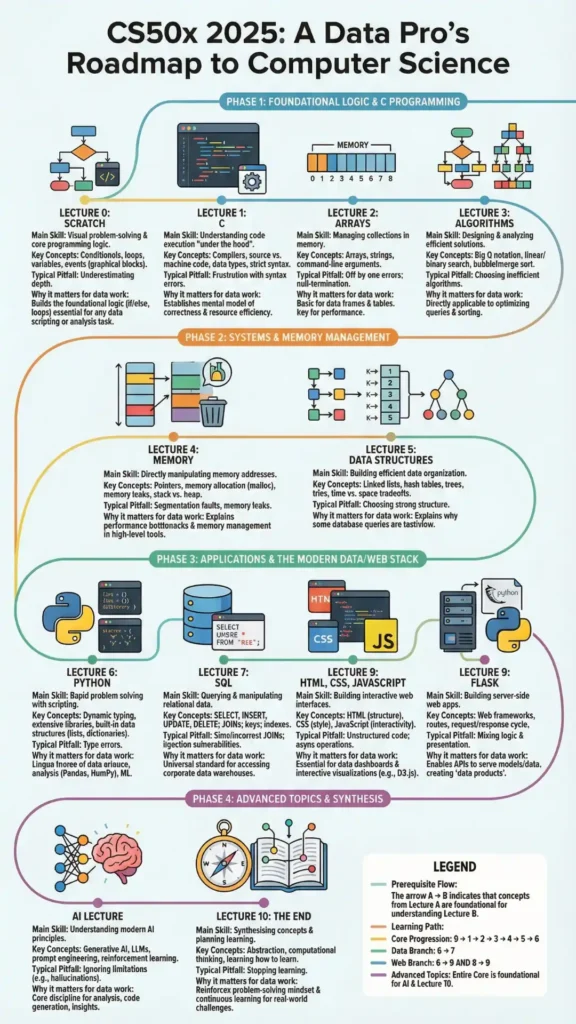
The CS50x curriculum can be viewed as a three-phase journey, moving from low-level fundamentals to high-level abstractions and finally to full-stack application development. Each phase builds skills that are directly applicable to data-centric roles.
1.1. Phase 1: Foundations in C (Lectures 0-5)
The course begins not with a conventional language, but with the visual programming environment Scratch, before quickly transitioning to C. This initial phase is dedicated to core programming concepts, manual memory management (Lecture 4), and fundamental data structures like hash tables, trees, and tries (Lecture 5). For a data professional, working in a low-level language like C builds a crucial “mechanical sympathy”—an intuitive understanding of how data is stored, addressed, and manipulated at a foundational level. This knowledge is invaluable for diagnosing performance bottlenecks and writing optimized code, even in high-level languages like Python.
1.2. Phase 2: Abstraction and Modern Tooling (Lecture 6 & 6.5)
This phase marks a pivotal transition to Python, which the course presents as a high-level, “batteries-included” language. Lecture 6 powerfully illustrates this shift by re-implementing complex C programs, such as a spell-checker and image filters, in just a few lines of Python, leveraging its rich ecosystem of libraries. This directly mirrors the data scientist’s reliance on the Python ecosystem (Pandas, NumPy, Scikit-learn). The course then dives into Artificial Intelligence (Lecture 6.5), covering a spectrum of topics from foundational concepts like decision trees and reinforcement learning to modern applications like Large Language Models (LLMs) and prompt engineering.
1.3. Phase 3: The Data and Web Stack (Lectures 7-9)
The final phase of the course focuses on integrating these skills to build complete, data-driven applications. This section covers managing and storing data—for instance, in the CSV files used in the lecture examples—and using the Flask framework to build dynamic web applications that can interact with that data (Lecture 9). This phase acts as a capstone, teaching data professionals how to move beyond standalone scripts and analyses. It provides the skills to build interfaces where data can be stored, retrieved, and presented to end-users through a custom web front-end, turning an analysis or model into a usable data product.
2. 10 High-Leverage Takeaways for Data Practitioners
- A Low-Level C Foundation Builds a Performance Mindset: Manually managing memory in C, a topic contrasted with Python’s automatic memory management in Lecture 6, forces an understanding of computational cost. This builds an intuition for performance that helps data professionals write more efficient Python code and recognize why certain operations are more expensive than others.
- Data Structures Are Practical Tools, Not Just Theory: As discussed in Lecture 5, understanding the “upsides and downsides” of structures like hash tables is directly applicable to data work. This theoretical knowledge informs practical decisions, such as choosing a Python
setordictfor O(1) average-time complexity lookups during feature engineering, which is vastly more performant than an O(n) search through a list when deduplicating millions of records. - Python’s Real Power is its Ecosystem of Libraries: Lecture 6 demonstrates implementing image filters and a spell-checker in a fraction of the time and code required in C. This highlights how Python’s vast ecosystem of libraries—the same ecosystem that includes Pandas, NumPy, and Matplotlib—is the true engine of productivity in data science.
- Learning How to Learn is the Ultimate Skill: A stated goal in Lecture 6 is to equip students with the ability to “teach yourself a new language” by bootstrapping from C to Python. For data practitioners in a rapidly evolving field, this meta-skill is essential for staying current with new tools, frameworks, and technologies.
- Embrace Pythonic Error Handling for Resilient Pipelines: The course contrasts C’s reliance on special return values to signal errors with Python’s more expressive
try...exceptblocks (Lecture 6). This exception-handling model is far superior for building robust and debuggable data pipelines that can gracefully handle unexpected issues without failing silently. - APIs Are the Gateway to Modern Data Applications: The live-coded AI chatbot in Lecture 6.5, which uses the OpenAI API, demonstrates a critical modern skill. Proficiency with APIs is essential for accessing third-party datasets, using cloud-based machine learning models, and integrating data-driven insights into larger software applications.
- Server-Side Logic is How You Go from Analysis to Application: The Flask examples from Lecture 9 show how a back-end framework acts as the bridge between a data source (like a CSV file or database) and a user. This is the key skill that allows data professionals to build interactive dashboards, ML model interfaces, and other data products that go beyond a static report.
- Server-Side Validation Protects Data Integrity: Lecture 9 emphasizes that client-side validation is a user convenience, not a security measure, and can be easily bypassed. Enforcing data quality rules and checks on the server is a fundamental principle for maintaining the integrity and reliability of any dataset. This is the first line of defense for data quality, preventing malformed or invalid entries from ever polluting your training data or breaking a downstream model.
- Templating Separates Analysis from Presentation: The course demonstrates how the Jinja templating engine in Flask uses simple logic like
{% for sport in sports %}to dynamically generate HTML (Lecture 9). This principle of separating logic from presentation is directly applicable to creating scalable data reports and dashboards, where the visual layer automatically adapts to changes in the underlying data. - Understanding AI Fundamentals Demystifies the Hype: Lecture 6.5 provides a first-principles look at concepts like decision trees, reinforcement learning, and neural networks. This foundational knowledge provides a mental model for how modern AI tools, including LLMs, actually work, allowing a data scientist to use them more effectively, critically, and with an awareness of their limitations.
3. Recommended Study Paths
3.1. Track 1: The Beginner (New to Programming)
Target: Individuals with little to no programming experience who want a strong, comprehensive foundation.
Recommendation:
- Follow the course sequentially from Lecture 0 through Lecture 9.
- Do not skip the C lectures; the rigorous, low-level thinking is invaluable for building a deep understanding of how computers work.
- Pay close attention to the transition from C to Python in Lecture 6, as it clearly illustrates the trade-offs and advantages of high-level languages.
3.2. Track 2: The Intermediate (Knows a Language, New to CS)
Target: Professionals (e.g., analysts familiar with Python/R scripts) who lack formal computer science training.
Recommendation:
- Focus heavily on Lectures 4 (Memory) and 5 (Data Structures). This is the core CS theory that provides the biggest leverage for writing performant and scalable code.
- Treat Lecture 6 (Python) as a review, but pay special attention to the comparisons with C to understand language design trade-offs.
- Prioritize Lecture 9 (Flask) to learn how to structure a full-stack application, a skill that bridges the gap between writing standalone scripts and building data products.
3.3. Track 3: The Data Scientist Refresher
Target: Experienced data scientists looking to solidify foundational knowledge and understand modern tooling.
Recommendation:
- Review Lecture 5 (Data Structures) to refresh knowledge on the performance characteristics of different ways to organize data.
- Deep-dive into Lecture 6.5 (AI) to get a clear, first-principles understanding of the technology behind the LLMs and generative tools now common in the industry.
- Focus on Lecture 9 (Flask) as a practical guide for deploying models and building interactive data applications—a key “last-mile” skill for delivering value.
Conclusion: From Code to Craft
Ultimately, a course like CS50x offers more than just a tour of programming languages and concepts. For the data professional, it provides the intellectual toolkit to move from being a user of tools to a builder of solutions. The principles of memory management, data structures, and full-stack architecture are not academic hurdles; they are direct levers for creating data products that are more efficient, robust, and valuable. By investing in these foundations, you transition from simply analyzing data to crafting data-driven applications with confidence and expertise.